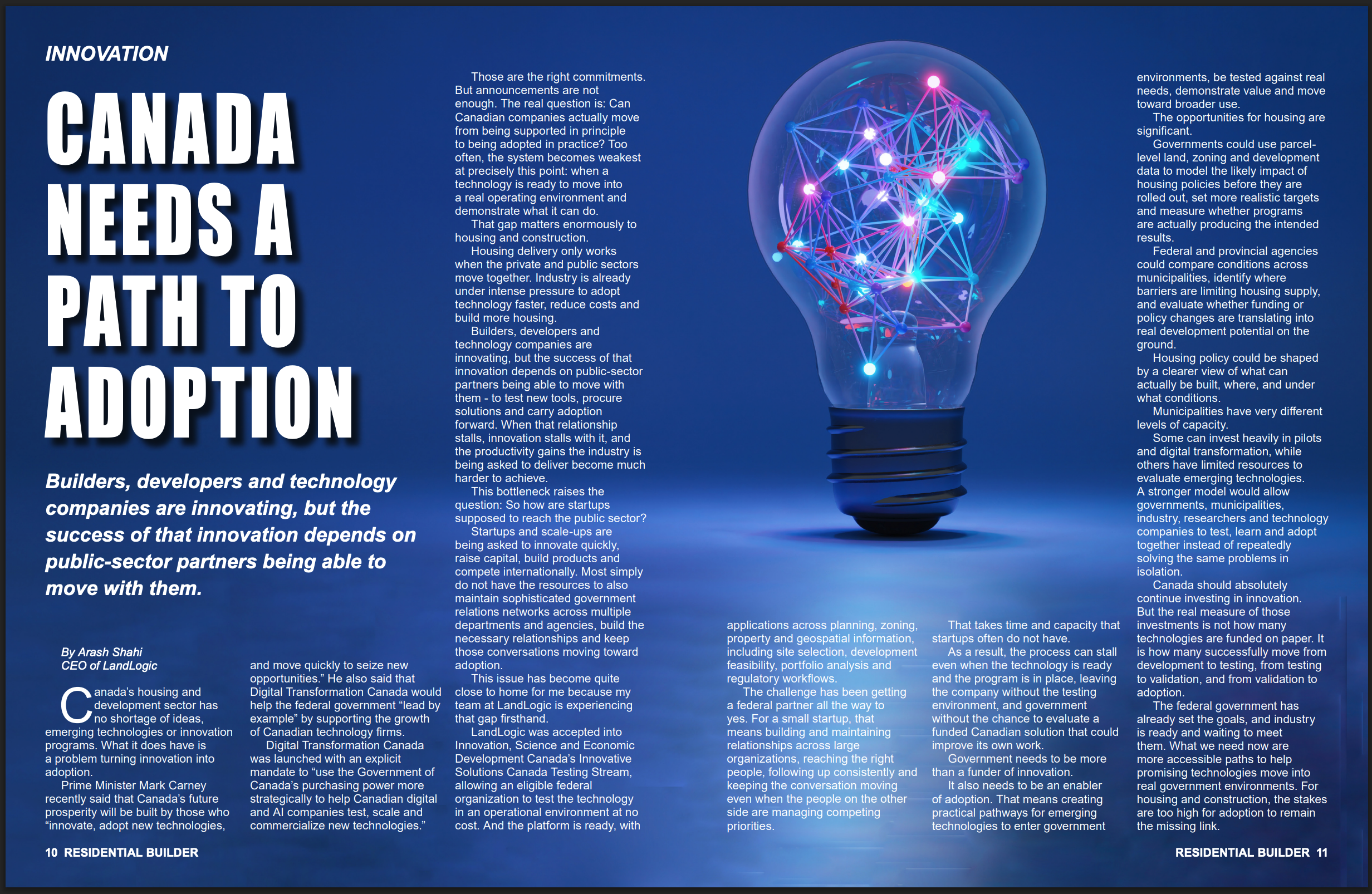
Canada needs a path to adoption.
RESCON Newsletter: Residential Builder
October 5th, 2026 | Page 10
Canada’s challenge is no longer generating innovative technology. It is creating a clear path for that technology to be adopted by government. In housing and construction especially, innovation only delivers results when the public and private sectors can move together. While governments have introduced funding programs and initiatives to support Canadian AI and digital companies, startups still face a major bottleneck when they are ready to move from development into real operating environments.
LandLogic’s acceptance into Innovation, Science and Economic Development Canada’s Innovative Solutions Canada Testing Stream illustrates both the opportunity and the challenge: the technology is ready and federal testing can be funded, but companies still need public-sector partners willing and able to test, procure and advance promising solutions.
The article argues that government should act not only as a funder of innovation, but as an enabler of adoption by creating practical pathways for emerging technologies to be tested against real needs, demonstrate value and move toward broader use. For housing, the opportunity is significant: governments could use parcel-level land, zoning and development information to model policy impacts, set more realistic housing targets, compare conditions across municipalities and understand whether funding or policy changes are actually unlocking development.
Canada has the technology and talent; what is missing is a more accessible route from development to testing, validation and ultimately adoption.

RESCON NEWSLETTER: Canada has no shortage of promising technology. The real challenge is creating a practical path for those solutions to move into real government environments, prove their value, and advance from testing to broader adoption.
LandLogic is seeking a federal testing partner through Innovative Solutions Canada to put AI-powered land and development intelligence to work on real housing, policy and public-land decisions.
The Due Diligence Report gives users a faster way to understand the key factors that could impact a property before moving forward, bringing zoning, conservation and environmental constraints, nearby development activity, Official Plan land use, and utility infrastructure into one focused view.
RESCON NEWSLETTER: As planning, permitting and housing systems become more digital, the question isn’t just where the technology operates — it’s who ultimately owns and controls the infrastructure Canada depends on.
LandLogic is excited to be working with Evergreen through the Evergreen Brick Works Technology Development Site, part of the Ontario Centre of Innovation’s Critical Industrial Technologies initiative. Over a three-month industry validation and commercialization project, LandLogic will work through Evergreen’s ecosystem to test and refine its AI-powered property intelligence capabilities.
Adding a new municipality to a property intelligence platform is far more complex than placing another pin on a map. That's why LandLogic prioritizes expansion based on where our enterprise customers need to work next—ensuring every new location delivers real value while strengthening the platform for everyone.
RESCON NEWSLETTER: This article explores a vision for what building a home could look like by 2036. With every property connected through a trusted digital record, AI could support faster decisions, fewer delays, and a more connected building process.
Members of the LandLogic team contributed to the Ontario chapter of Digital Transformation of Building Permitting, an international open-access publication. The chapter explores why Ontario's high level of digitalization has not translated into faster approvals and offers recommendations for building a more connected permitting ecosystem.
RESCON NEWSLETTER: RESCON has joined LandLogic, One Ontario, and RCI Lab to help build a province-wide, AI-enabled permitting platform. Together, we're advancing a shared vision for faster approvals, better collaboration, and modern permitting infrastructure across Ontario.
Through the Google for Startups Accelerator, LandLogic transformed a broad vision into Parcella, a conversational AI platform for property feasibility and permitting. The product is now becoming part of One Ontario’s province-wide AI-enabled permitting platform.
RESCON NEWSLETTER: Ontario doesn’t need 444 separate permitting systems. Municipalities are building disconnected portals, workflows, forms, and datasets. LandLogic is has a solution: a centralized, AI-enabled permitting platform powered by shared infrastructure and standardized zoning, planning, and property data.
RESCON NEWSLETTER: Consumer-first permitting helps homeowners get clearer answers about what they can build, what rules apply, and what approvals they may need before starting a project. Parcella supports this shift by turning complex property, zoning, and permitting information into practical guidance that helps owners understand their property’s potential with more clarity and confidence.
LandLogic and Teranet are launching the Enhanced Zoning Report in the GeoWarehouse Store, providing deeper, address-specific zoning intelligence. It includes conditions, setbacks, heights, lot coverage, and other compliance factors that determine what can realistically be built, helping professionals reduce research time and make decisions with greater confidence.
LandLogic is introducing Parcella, a new way for property owners to get clear, reliable answers about their property. By bringing together real data and municipal rules, Parcella helps users understand what’s possible, what could affect them, and how to make better decisions with less risk—so they can get more out of their property.
LandLogic has advanced to Phase 2 of the AC:Studio Sustainable Development Cohort, accelerating our next phase of growth as we prepare to bring a new, more accessible approach to property intelligence to a broader audience.
RESCON NEWSLETTER: Cost is a significant barrier to real estate technology adoption, with custom AI tools often requiring large upfront investments and specialized expertise. By structuring projects to leverage tax credits and grants from the outset, firms can dramatically reduce development costs and turn technology into a leveraged investment.
LandLogic has been selected to join Canada’s official AI delegation at VivaTech 2026 in Paris. Led by Scale AI, the delegation highlights leading Canadian companies advancing AI and digital infrastructure. LandLogic will showcase how it transforms zoning, planning, and property data into AI infrastructure while connecting with global partners and investors.
Economic development is shifting from marketing to product. At EDCO 2026, one theme stood out: the communities winning investment aren’t the ones with the best pitch, but the ones with the most investment-ready land. Explore how faster access to zoning, planning, and property data is becoming the new competitive edge.
LandLogic has been selected for the 2026 Google for Startups Accelerator: Canada, joining a national cohort of AI-driven companies. The program provides mentorship, technical support, and access to Google’s AI ecosystem to help startups scale.
RESCON NEWSLETTER: Canada’s housing challenge is increasingly about delivery, not just policy. The article argues that scaling housing, especially missing-middle housing, requires repeatable delivery systems and better land intelligence to identify viable sites and move projects forward faster.
School data significantly influences home buying decisions, yet in Ontario buyers must navigate multiple sources to understand catchments, rankings, and eligibility rules. LandLogic’s School Report consolidates this complexity into a single, address-based view, providing clear rankings and program details to help buyers and professionals make confident, informed decisions.
RESCON NEWSLETTER: School zones strongly influence demand and feasibility, but are rarely considered early in planning. This article explains why treating school catchments and rankings as core feasibility inputs, rather than late-stage checks, leads to clearer assumptions and more predictable development outcomes.
RESCON NEWSLETTER: In 2025, artificial intelligence crossed a real tipping point in residential construction. What was once viewed as a futuristic concept became a daily operational tool across site selection, feasibility, and early project planning. Looking ahead to 2026, the firms that succeed will be those that embed AI into everyday thinking, not as a shortcut, but as a smarter way to build.
In 2025, LandLogic advanced property intelligence by standardizing fragmented data across Canada. With expanded coverage across 82 municipalities, upcoming entry into British Columbia, new partnerships, and major product launches, LandLogic strengthened its position at the center of the property intelligence landscape. Looking ahead to 2026, our focus remains on removing friction from property research and due diligence so land-use decisions can move faster and with greater confidence.
During our recent webinar with Teranet on the Basic Zoning Report in GeoWarehouse, realtors and property professionals asked insightful questions about zoning accuracy, updates, commercial uses, and more. We’ve summarized the top questions here so you can quickly understand how zoning intelligence supports better research, marketing, and decision-making.