TL;DR: Expanding a property intelligence platform into a new municipality is complex, time-intensive infrastructure work. That’s why LandLogic prioritizes growth based on where enterprise customers need to work next—so every expansion solves a real business need while strengthening the platform for everyone.
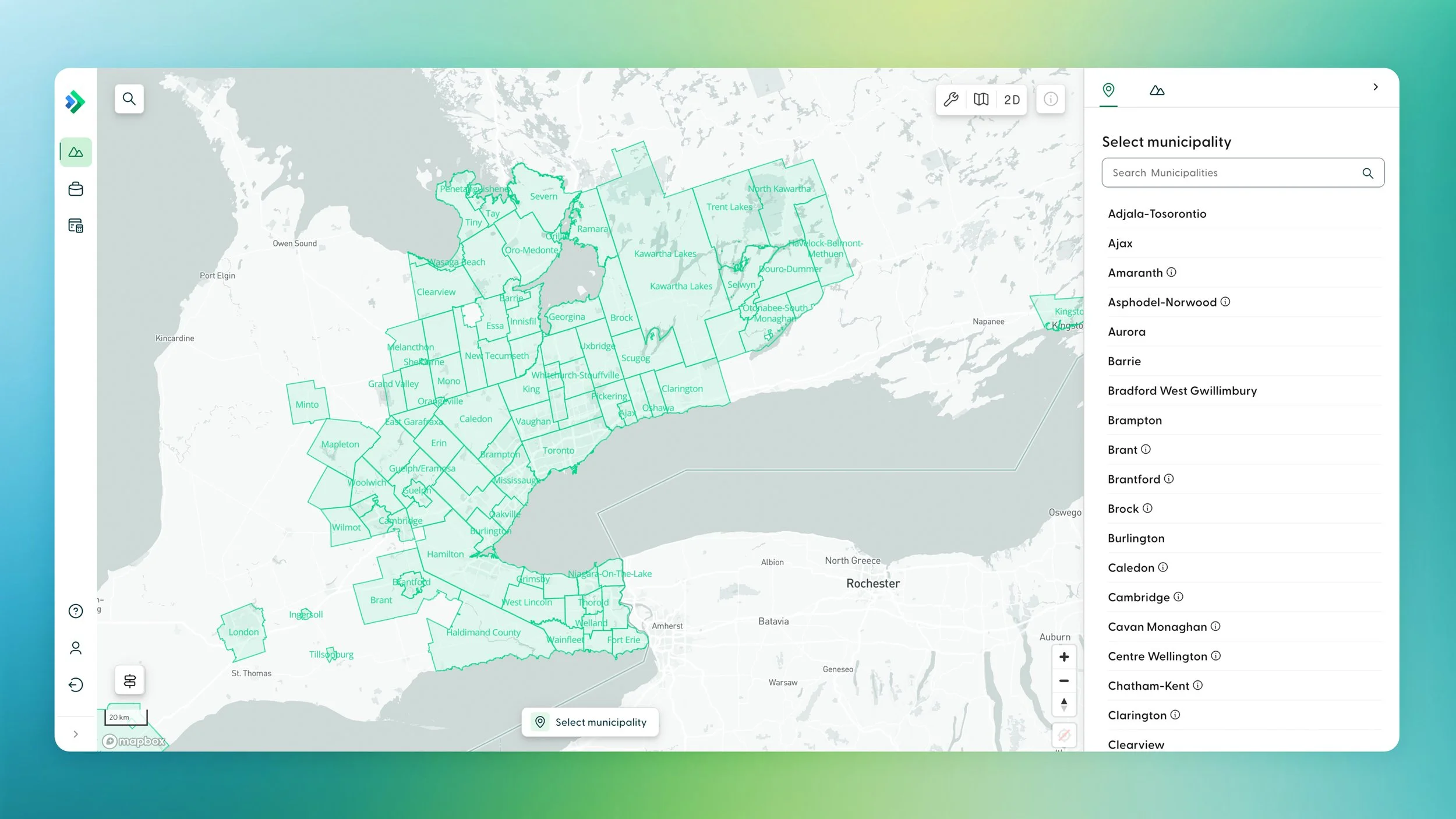
When it comes to your land-use software, every new municipality looks like a pin on a map. Behind the scenes, it requires significant, complex infrastructure work.
Over the past few weeks, LandLogic has expanded its platform into another group of Ontario municipalities, including Caledon, Chatham-Kent, Niagara-on-the-Lake, Uxbridge, Port Colborne, and Tillsonburg.
But adding new cities isn't really the story. That’s just the result.
The real story is why expanding property intelligence is so difficult—and why that makes it even more important to expand in the places where it will create the most value.
Property information does not scale neatly across geographic boundaries. Every municipality publishes zoning, planning, and property data differently. The same type of information may live in a GIS layer in one city, a PDF in another, a web portal somewhere else, or not be available in a structured format at all. Naming conventions differ. Boundaries differ. Update cycles differ. Even seemingly simple datasets can require significant work before they can be used consistently across jurisdictions.
That means geographic expansion is not just a matter of switching on another municipality.
Each new location requires data to be discovered, ingested, interpreted, standardized, mapped to a common structure, quality-checked, and maintained over time. If that process is entirely manual, expansion becomes slow and expensive. If it is entirely automated, inconsistencies and edge cases can undermine trust.
This is one of the core technical challenges LandLogic has been working to solve.
We have developed systems that use AI and automation to make expansion faster and more repeatable, while keeping humans in the loop for the decisions that require judgment. Automation helps identify, process, and standardize new data sources at scale. Human review helps validate outputs, resolve exceptions, and ensure the information is useful before it becomes part of the platform.
That combination matters because scale alone is not the goal.
When expanding into a new municipality requires real technical effort, the question becomes: where will that effort create the most value?
For enterprise customers, the answer is often driven by where their business is going next.
A developer may begin evaluating sites in Niagara after years of working in the GTA. A lender may need coverage in Southwestern Ontario. A consultant may suddenly be supporting projects across a new group of municipalities. Their business can move quickly, but the underlying information infrastructure often does not.
That is why many of our expansion priorities begin with customer demand.
Rather than treating municipal coverage as a static roadmap built in isolation, we use real customer needs to help determine where new infrastructure should be built next. When a municipality is added, its property data is integrated into our standardized property intelligence infrastructure, becoming part of a shared foundation that supports future workflows, applications, and customers.
The result is a more deliberate approach to growth.
And AI and automation help make expansion more efficient. Human oversight helps maintain quality. Customer demand helps ensure that the effort is directed toward the places where it can have the greatest immediate impact.
But the bigger objective is to build property intelligence infrastructure that can keep expanding as the market changes—without forcing customers to wait for the technology to catch up.
Check out our current coverage list here. And if you’d like to request a new location, send us a message, or contact us to discuss enterprise plans.

Adding a new municipality to a property intelligence platform is far more complex than placing another pin on a map. That's why LandLogic prioritizes expansion based on where our enterprise customers need to work next—ensuring every new location delivers real value while strengthening the platform for everyone.
RESCON NEWSLETTER: This article explores a vision for what building a home could look like by 2036. With every property connected through a trusted digital record, AI could support faster decisions, fewer delays, and a more connected building process.
Members of the LandLogic team contributed to the Ontario chapter of Digital Transformation of Building Permitting, an international open-access publication. The chapter explores why Ontario's high level of digitalization has not translated into faster approvals and offers recommendations for building a more connected permitting ecosystem.
RESCON NEWSLETTER: RESCON has joined LandLogic, One Ontario, and RCI Lab to help build a province-wide, AI-enabled permitting platform. Together, we're advancing a shared vision for faster approvals, better collaboration, and modern permitting infrastructure across Ontario.
Through the Google for Startups Accelerator, LandLogic transformed a broad vision into Parcella, a conversational AI platform for property feasibility and permitting. The product is now becoming part of One Ontario’s province-wide AI-enabled permitting platform.
RESCON NEWSLETTER: Ontario doesn’t need 444 separate permitting systems. Municipalities are building disconnected portals, workflows, forms, and datasets. LandLogic is has a solution: a centralized, AI-enabled permitting platform powered by shared infrastructure and standardized zoning, planning, and property data.
RESCON NEWSLETTER: Consumer-first permitting helps homeowners get clearer answers about what they can build, what rules apply, and what approvals they may need before starting a project. Parcella supports this shift by turning complex property, zoning, and permitting information into practical guidance that helps owners understand their property’s potential with more clarity and confidence.
LandLogic and Teranet are launching the Enhanced Zoning Report in the GeoWarehouse Store, providing deeper, address-specific zoning intelligence. It includes conditions, setbacks, heights, lot coverage, and other compliance factors that determine what can realistically be built, helping professionals reduce research time and make decisions with greater confidence.
LandLogic is introducing Parcella, a new way for property owners to get clear, reliable answers about their property. By bringing together real data and municipal rules, Parcella helps users understand what’s possible, what could affect them, and how to make better decisions with less risk—so they can get more out of their property.
LandLogic has advanced to Phase 2 of the AC:Studio Sustainable Development Cohort, accelerating our next phase of growth as we prepare to bring a new, more accessible approach to property intelligence to a broader audience.
RESCON NEWSLETTER: Cost is a significant barrier to real estate technology adoption, with custom AI tools often requiring large upfront investments and specialized expertise. By structuring projects to leverage tax credits and grants from the outset, firms can dramatically reduce development costs and turn technology into a leveraged investment.
LandLogic has been selected to join Canada’s official AI delegation at VivaTech 2026 in Paris. Led by Scale AI, the delegation highlights leading Canadian companies advancing AI and digital infrastructure. LandLogic will showcase how it transforms zoning, planning, and property data into AI infrastructure while connecting with global partners and investors.
Economic development is shifting from marketing to product. At EDCO 2026, one theme stood out: the communities winning investment aren’t the ones with the best pitch, but the ones with the most investment-ready land. Explore how faster access to zoning, planning, and property data is becoming the new competitive edge.
LandLogic has been selected for the 2026 Google for Startups Accelerator: Canada, joining a national cohort of AI-driven companies. The program provides mentorship, technical support, and access to Google’s AI ecosystem to help startups scale.
RESCON NEWSLETTER: Canada’s housing challenge is increasingly about delivery, not just policy. The article argues that scaling housing, especially missing-middle housing, requires repeatable delivery systems and better land intelligence to identify viable sites and move projects forward faster.
School data significantly influences home buying decisions, yet in Ontario buyers must navigate multiple sources to understand catchments, rankings, and eligibility rules. LandLogic’s School Report consolidates this complexity into a single, address-based view, providing clear rankings and program details to help buyers and professionals make confident, informed decisions.
RESCON NEWSLETTER: School zones strongly influence demand and feasibility, but are rarely considered early in planning. This article explains why treating school catchments and rankings as core feasibility inputs, rather than late-stage checks, leads to clearer assumptions and more predictable development outcomes.
RESCON NEWSLETTER: In 2025, artificial intelligence crossed a real tipping point in residential construction. What was once viewed as a futuristic concept became a daily operational tool across site selection, feasibility, and early project planning. Looking ahead to 2026, the firms that succeed will be those that embed AI into everyday thinking, not as a shortcut, but as a smarter way to build.
In 2025, LandLogic advanced property intelligence by standardizing fragmented data across Canada. With expanded coverage across 82 municipalities, upcoming entry into British Columbia, new partnerships, and major product launches, LandLogic strengthened its position at the center of the property intelligence landscape. Looking ahead to 2026, our focus remains on removing friction from property research and due diligence so land-use decisions can move faster and with greater confidence.
During our recent webinar with Teranet on the Basic Zoning Report in GeoWarehouse, realtors and property professionals asked insightful questions about zoning accuracy, updates, commercial uses, and more. We’ve summarized the top questions here so you can quickly understand how zoning intelligence supports better research, marketing, and decision-making.
RESCON NEWSLETTER: Ontario’s multiplex and ADU policies opened the door, but scattered bylaws, unclear eligibility, and slow permitting still stall projects. The article shows how AI can create clear answers, quickly flag eligible lots, and reduce errors early in the process. With modern, AI-enabled workflows, multiplex and ADU projects can move far faster, making gentle density more achievable across the province.
RESCON NEWSLETTER: Canada’s “Buy Canadian” mandate must include digital infrastructure — not just materials. Relying on foreign systems weakens digital sovereignty and coordination in housing data. He calls for investing in Canadian-built, AI-ready platforms like LandLogic to unify zoning, planning, and valuation data. Building “digital land,” is key to building Canada’s future.
PODCAST: This episode explores how intelligent data is transforming real estate. It looks at how turning static zoning and planning records into live, connected intelligence is reshaping how professionals assess sites, speed up approvals, and unlock development potential. The discussion highlights why AI-ready infrastructure is becoming essential to Canada’s property market.
RESCON NEWSLETTER: Canada’s housing crisis isn’t just about supply—it’s about data. In this piece, LandLogic CEO Arash Shahi reveals how fragmented, outdated zoning information is slowing development, driving up costs, and blocking AI-driven innovation. He argues that building an AI-ready property data infrastructure is key to unlocking faster approvals, smarter planning, and real progress on housing supply.
The new collaboration between LandLogic and Teranet is a game-changer. LandLogic’s Basic Zoning Report is providing real estate professionals across Ontario with instant access to critical zoning data. This powerful new capability transforms the due diligence process, offering an efficient and timely way to uncover a property’s highest and best use. Let’s take a closer look at how various professionals can harness this enhanced intelligence to drive success.
We are proud to welcome Hugh O’Reilly as the new Chair of LandLogic’s Board of Directors. A visionary leader with a proven track record in governance, strategy, and innovation, Mr. O’Reilly brings a depth of expertise that will be instrumental in shaping LandLogic’s next chapter.
LandLogic Solutions Inc. is proud to announce a strategic partnership with Teranet Inc., Ontario’s exclusive provider of land registry data and a trusted steward of property intelligence. Together, we are launching a new capability: instant zoning intelligence, embedded directly into GeoWarehouse, a platform used by real estate and land professionals across Ontario.
CMHC’s Housing Design Catalogue is a promising step toward faster, more affordable housing development. But even with pre-approved designs, projects can stall due to zoning restrictions, infrastructure constraints, and regulatory complexity. LandLogic bridges this gap by consolidating critical data; helping developers and municipalities identify build-ready sites in minutes, not weeks.
Residential Multiplex Infill (RMI) streamlines multi-unit development by identifying properties that align with zoning and funding opportunities like CMHC’s MLI Select. LandLogic simplifies this process with data-driven tools for zoning analysis, site selection, and ROI optimization—empowering real estate professionals to make smarter, faster decisions.
2024 has been a year of significant progress for LandLogic as we worked to equip the real estate industry with meaningful tools. This year, we launched innovative solutions that help identify ideal sites, assess property values, and evaluate risks and opportunities—providing the insights needed to streamline real estate projects.